Iconography and Chronology of the Inget Tolgoi Statue
Keywords:
Inget Tolgoi, Buddhism, Rouran Khaganate, Stone statue, MudraAbstract
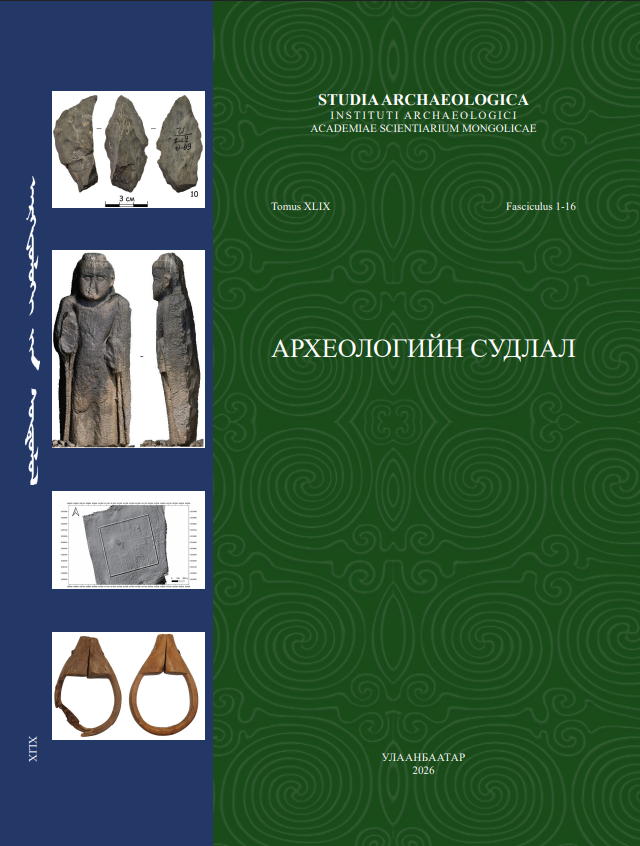
The historical timeline of Buddhism introduction to Mongolia has long been studied through literary sources. However, archaeological evidence to substantiate these records remains insufficient. The anthropomorphic stone statue at Inget Tolgoi, located in Selenge Soum of Bulgan Province, is a crucial artifact for clarify the history of early Buddhist dissemination. Its general physical form, hairstyle, facial features, hand gestures (mudras), and the attire is resembled to the traditional iconography of the Buddha. These iconographic attributes carry profound symbolic meanings. The protrusion on the head represents the ushnisha. The right hand is depicted in the abhaya mudra, representing giving. Meanwhile the left hand shows the varada mudra, signfying the granting of boons. The figure is also draped in a kesa (a robe worm by monk), deeply featureing the universal compassion and protection. Similar Buddhist sculptures have been extensively recovered from Gandhara in Central Asia and temple ruins from the Northern Dynasties of China. Regionally, the most closely related artifact is a bronze triad of the Maitreya Bodhisattva dating to 441 CE, discovered at the Ivolga settlement in Buryatia. Archaeological and ethnographic data indicate that the Inget Tolgoi statue was relocated several times for various reasons. However, we hypothesize that it was originally enshrined temple atop Inget Tolgoi hill. Based on comparative analysis and laboratory findings, this Buddhist-style statue is dated to the 5th–6th centuries CE. This period corresponds to the late of the Rouran Khaganate.
Ингэт толгойн хөшөөний дүрслэл ба он цагийн асуудал
Хураангуй. Монгол нутагт бурхны шашин хэдий үед анх дэлгэрсэн тухай түүхийн асуудлыг эрдэмтэн судлаачид сурвалж бичгийн мэдээнд тулгуурлан сонирхон судалж ирсэн боловч түүнийг батлах археологийн хэрэглэгдэхүүн одоо хүртэл хангалттай бус байна. Харин түрүү үеийн дэлгэрэлтийн түүхийн асуудлыг цаашид нэхэн тодруулахад Булган аймгийн Сэлэнгэ сумын нутагт орших Ингэт толгойн хүн чулуун хөшөө чухал хэрэглэгдэхүүн болох бөгөөд биеийн ерөнхий төрх, үсний засал, нүүр царай, хоёр гарын байрлал, хувцас зэргээрээ бурхан багшийн дүр төрхтэй ижил байна. Дүрслэлийн эдгээр шинж нь цаанаа нарийн утга бэлгэдэлтэй ба хөшөөний тэргүүнд үснирийг (ushnisha) овгор байдлаар товойлгон урласан бол баруун гар нь дээдийг өгөхийн мутарлаг (abhaya mudra), зүүн гар нь авралыг өгөхийн мутарлаг (varaba mudra) бөгөөд бурхны номт дээл (kesa) өмссөн байдлаар дүрслэн харуулсан нь хамаг бүхнийг энэрч хамгаалах чанад агуулгатай аж. Үүнтэй ижил төстэй бурхан дүрсэлсэн хөшөө Дундад Азийн Гандхара, Умардын төрийн үеийн сүм хийдийн тууриас олон тоогоор олдсоны зэрэгцээ одоогоор бүс нутгийн хэмжээнд хамгийн ойролцоо баримт нь Буриадын нутаг дахь Иволгийн дурсгалаас олдсон 441 онд холбогдох гурван майдар бодсидавагийн дүрт хүрэл баримал тооцогдоно. Ингэт толгойн хөшөөг янз бүрийн шалтгаанаар хэд хэдэн удаа зөөсөн болохыг археологи болон угсаатны зүйн мэдээ баримт нотлох бөгөөд бидний таамаглаж буйгаар анх Ингэт толгойн орой дээрх тахилын сүмийн үүдэнд оршиж байсан хэмээн үзэв. Харьцуулсан болон лабораторийн судалгааны үр дүнд тулгуурлан Ингэт толгойн бурхны дүрт хөшөөний он цагийг НТ V-VI зууны үе буюу Жужаны хаант улсын төгсгөл үед холбогдуулан үзэж байна.
Түлхүүр үг: Ингэт толгой, Бурхны шашин, Жужаны хаант улс, Хөшөө чулуу, мутарлаг
217
References
Amartuvshin Ch., Badma-Oyuu B. “Mongolyn khun chuluu”. [Stone Statue of Mongolia] Archaeological Relics of Mongolia vol. 6. Edited by S.Chuluun, D.Tseveendorj, Ulaanbaatar, 2016.
Amgalan, N. “Inget tolgoi dakh khün chuluug khartsuulan sudlakh ni” [A Comparative Study of the Anthropomorphic Statue at Inget Tolgoi]. Proceedings of the International Scientific Conference on Buddhism and Archaeology. Ulaanbaatar, 2024.
Bayar, D. 1990 ond Bulgan, Selenge, “Töv aimgiin nutagt ajillasan kheeriin shinjilgeenii angiin tailan” [Report of the Field Research Team in the Territories of Bulgan, Selenge, and Töv Provinces in 1990]. Institute of Archaeology, Mongolian Academy of Sciences, Manuscript Fund. Ulaanbaatar, 1990.
Bira, Sh. “Mongol dakhi Buddyn shashny tüükhichilsen toim” [Historical Overview of Buddhism in Mongolia]. Lam naryn setgüül [Journal of Lamas], no. 3. Ulaanbaatar, 2010.
Bunce, Fredrick W. Mudras in Buddhist and Hindu Practices: An Iconographic Consideration. New Delhi: D.K. Printworld, 2009.
Delgerjargal, P. "Torgony zamyn noyorkhlyn tölöökh Jujan ulsyn temtsel." [The Struggle for the Silk Road: Rouran and Northern Wei], Historia Mongolarum, Tom. XIX, fasc. 2, Ulaanbaatar, 2020.
Zava Damdin Luvsandayan. Ikh mongol orond burkhany shashin delgersen tüükh “Altan devter.” [The History of the Spread of Buddhism in Greater Mongolia]. Translated from Tibetan by S. Gantumur. Ulaanbaatar, 2018.
Namnandorj, O. “1953 ony ekspeditsiin zamyn temdeglelees.” [From the Route Journal of the 1953 Expedition] Shinjlekh ukhaan, 1956, №3. Vol. II, Ulaanbaatar, 2003.
Munkhnaran, N. Ikh tüükhiin zam /Durshamj, durdatgal, tüükh/. [The Path of Great History (Memoirs, Recollections, and History)], Ulaanbaatar, 2023.
Sukhbaatar, G. Mongol Nirun uls (330-555) [The Mongol Rouran Khaganate (330-555)]. Edited by Ch. Dalai. Ulaanbaatar, 1992.
Ser-Odjav, N. “Mongolyn töv umar khesgiig arkheologiin talaar sudlan shinjilsen ni [Archaeological Research in the North-Central Part of Mongolia ]” Studia Archaeologica, Tom. IV, Fasc. 7, Ulaanbaatar, 1965.
Ser-Odjav, N. Ertnii Türegüüd (VI-VIII)[ The Ancient Turks]. Studia Archaeologica, Fasc. 2, Ulaanbaatar, 1970.
Tsogtbaatar, B., Sodnomjamts D., Munkhbayar L., Ankhsanaa G., and Nandin-Erdene N.“Öv soyolyn golomt” tösliin khüreend Bulgan aimgiin Selenge sumyn nutagt 2023 ond khiisen arkheologiin maltlaga, khaiguul sudalgaany ajlyn tailan [Report on Archaeological excavations conducted in Selenge soum, Bulgan province, Ulaanbaatar, 2023.
Rygdylon, E. R. “Kitayskiye znaki i nadpisi na arkheologicheskikh predmetakh s Selenge” [Chinese Signs and Inscriptions on Archaeological Artifacts from the Selenge River]. In Zapiski Buryat-Mongol’skogo nauchno-issledovatel’skogo instituta kul’tury. Ulan-Ude, 1957.
Sodnomjamts, D., L. Mönkhbayar, B. Tsogtbaatar, G. Ankhsanaa, N. Nandin-Erdene, and M. Uuganbayar. “Öv soyolyn golomt” tösliin khüreend Inget tolgoin dursgalt gazart khiisen arkheologiin sudalgaa." In Proceedings of the International Scientific Conference on Buddhism and Archaeology. Ulaanbaatar, 2024.
Masumoto, Tetsu. “Bronzovaya statuetka buddy iz ivolgi i eye znacheniye v istorii zabaykal’ya v V-VI vv. n.e.” [Bronze Statuette of Buddha from Ivolga and its Significance in the History of Transbaikalia in the 5th–6th Centuries AD]. [Ancient Cultures of Mongolia and Baikal Siberia: Proceedings of the International Scientific Conference (Irkutsk, May 3–7, 2011)], edited by A. V. Kharinskiy, Vol. 2. Irkutsk: Izd-vo IrGTU, 2011.
Khandsuren, Ts. Jujany khaant uls ba tüükhiin zarim sudalgaa [The Rouran Khaganate and Some Historical Research]. Ulaanbaatar, 2005.
Sukhbaatar, G. Mongolchuudyn ertnii övög [Ancient Ancestors of the Mongols]. Ulaanbaatar, 1980.
Tserensodnom, D. “Mongol oron dakh Buddyn shashny türüü üyeiin delgerelted kholbogdokh Li orny tukhai tovch temdeglel” [Brief Notes on the Li Country Related to the Early Spread of Buddhism in Mongolia]. Lam naryn setgüül, no. 3 (2010).
Enkhbat, G., Davaatseren B., and Bold R. Mongol ulsyn nutag dakh’ tüükh, soyolyn ül khödlökh dursgal. VII devter: Bulgan aimag [Immovable Historical and Cultural Monuments in the Territory of Mongolia. Vol. VII: Bulgan Province]. Ulaanbaatar, 2018.
Enkhtur, A. “Erdene daichin vangiin khoshuuny nutag dakh tüükh, soyolyn dursgaluud” [Historical and Cultural Monuments in the Territory of Erdene Daichin Wang Banner]. In Tüsheet khan aimgiin Erdene daichin vangiin khoshuuny tüükh soyol conference proceedings. Ulaanbaatar, 2025.
Eregzen, G. “Khünnüd burkhny shashin delgerch baisan uu?” [Was Buddhism Spread in the Xiongnu?]. In “Buddyn shashin ba arkheologi” [Buddhism and Archaeology] conference proceedings. Ulaanbaatar, 2022.
Xuchi. Stone buddha on the steppe and the shaping of imperial authority: Transmission of buddhism to the Turkic khaganate during the 6th to 8th century. “Ancient cultures of Mongolia, Baikal, Southern Siberia and Northern China” the 13th international conference. Ulaanbaatar, 2025.
Peter Stewart. Gandharan art and the classical world a short introduction. Archaeopress. 2024. https://doi.org/10.2307/jj.15135910
Kurt A. Behrendt. The art of Gandhara in the Metropolitan museum of art. Yale University press, 2007.
Kurt A. Behrendt. Gandhāran imagery as remembered by Buddhist communities across Asia. The Rediscovery and Reception of Gandhāran Art (Archaeopress 2022): 107–123 https://doi.org/10.32028/9781803272337-5
Shuangqiao Meng and Peining Li. From the Malay Peninsula to the Shandong Peninsula: The Transmission of Buddha Statues with Tight‑Fitting Robe in the Sixth Century. Religions 2023, 14, 84. https://doi.org/10.3390/rel14010084
《Bei shi》 Juan jiushiba 《Ruanruan》 Zhonghua shuju, 2000 nian, 2157 ye.
《Wei shu》 Juan yibaisan 《Ruanruan》 Zhonghua shuju, 2000 nian, 1549 ye.
(Liang) Shi Huijiao: 《Gao seng chuan》 Juan ba 《Fa ai chuan》, Zhonghua shuju, 1992 nian, di 312 ye.
He Zhiguo 《Shi lun zao qi fo tuo、pu sa xiang ming shi bu fu de xian xiang——yi zao qi jin tong fo xiang wei zhong xin》 Wen wu yan jiu 2021 nian di yi qi, 130-138 ye.
Ren Jiyu zhu bian: 《Zhong guo fo jiao shi》 Di yi juan, Zhong guo she hui ke xue chu ban she, 1981: 91.
Zhong hua shi ji tan yi shu guan、Qing zhou shi bo wu guan 《Qing zhou bei chao fo jiao zao xiang》 Bei jing chu ban she 2002 nian.
Downloads
Published
How to Cite
Issue
Section
License
Copyright (c) 2026 Sodnomjamts Damchaabadgar, Tsogtbaatar Batmunkh, Amgalan Norovtseden, Munkhbayar Lkhagvadorj, Ankhsanaa Ganbold, Nandin-Erdene Nyam-Osor, Uuganbayar Munkhtsogt

This work is licensed under a Creative Commons Attribution-NonCommercial 4.0 International License.
Copyright on any research article in the Studia archeologica is retained by the author(s).
The authors grant the Studia archeologica license to publish the article and identify itself as the original publisher.

Articles in the Studia archeologica are Open Access articles published under a Creative Commons Attribution-NonCommercial 4.0 International License - CC BY NC.
This license permits use, distribution and reproduction in any medium, provided the original work is properly cited.