Mongolian National Defense University Bibliometric capacity: the scientific and research work of teachers and researchers at the international level for delivery problems
Keywords:
Bibliometrics, Impact Factor, quartile ranking, h-index, DTIC, NATO STO, MNDU, international indexing, defense research, research strategyAbstract
In this article, the problem of bringing the "bibliometric" capabilities of the academic work of scientists and teachers of the Mongolian National Defense University (MNDU) to international standards is considered. Nowadays, the assessment of the bibliometric capacity of academic and research work of university academics and researchers is determined not only by the number of articles, but also by the actual influence, citations, and position of the research work in the academic environment. Therefore, we need to rank the key bibliometric metrics correctly and use them strategically. Basic bibliometric measures such as Impact Factor (IF), quartile system (Q1–Q4), citation analysis, and h-index were considered in the context of theoretical and practical issues, and a real quantitative analysis was performed on the results of the articles published by scientists, teachers, and researchers in the first quarter of 2026. Defense-specific databases such as DTIC, NATO STO, and MORS, and the TRL 1–9 scale were compared with civilian survey assessment scales.
The current state of the bibliometric capacity of the academic and research work of the teachers and researchers of Mongolia and MNDU was compared with the indicators of the world's military universities, and a map of the system of strategic goals for 2026-2028 was developed. As a result of the research, the bibliometric capacity of MNDU's academic and research work requires a shift toward qualitative
indicators, not quantitative growth, and Q1/Q2 journals, international cooperation, and DTIC/NATO registration are identified as the main ways to increase impact.
Үндэсний Батлан Хамгаалахын Их Сургуулийн багш, судлаачдын эрдэм шинжилгээ, судалгааны ажлын библиометрийн чадавхийг олон улсын түвшинд хүргэх асуудалд
Хураангуй. Энэхүү өгүүлэлд Үндэсний батлан хамгаалах их сургуулийн (ҮБХИС) эрдэмтэн судлаач, багш нарын эрдэм шинжилгээний ажлын “библиометр”- ийн чадавхийг олон улсын түвшинд хүргэх асуудлыг авч үзлээ. Өнөө үед их дээд сургуулийн эрдэмтэн багш, судлаачдын эрдэм шинжилгээ, судалгааны ажлын библиометрийн чадавхийн үнэлгээ нь зөвхөн нийтлэлийн тоонд тулгуурлах бус тухайн судалгааны ажлын бодит нөлөөлөл, иш татагдалт, академик орчинд эзлэх байр суурь зэргээр тодорхойлогддог болсон. Иймээс бид библиометрийн үндсэн хэмжүүрүүдийн чансааг зөв эрэмбэлж, стратегийн түвшинд ашиглах шаардлагатай байна. Библиометрийн үндсэн хэмжүүрүүд болох Impact Factor (IF), квартилийн систем (Q1–Q4), эшлэлийн шинжилгээ, h-index зэрэг үзүүлэлтүүдийг онолын болон практик асуудлын хүрээнд авч үзэн, 2026 оны 1-р улиралд хэвлэгдсэн эрдэмтэн багш, судлаачдын (ҮБХИС)-ийн нийтлэлийн үр дүнд бодит тоон шинжилгээ хийв. Батлан хамгаалахын салбарт тусгайлсан DTIC, NATO STO, MORS зэрэг мэдээллийн сан болон TRL 1–9 хэмжүүрийг иргэний судалгааны үнэлгээний хэмжүүртэй харьцуулан авч судаллаа.
Монгол Улс болон ҮБХИС-ийн багш, судлаачдын эрдэм шинжилгээ, судалгааны ажлын библиометрийн чадавхийн өнөөгийн байдлыг дэлхийн цэргийн их сургуулиудын үзүүлэлттэй харьцуулсан бөгөөд 2026–2028 оны стратегийн зорилтын тогтолцооны зураглалыг боловсруулав. Судалгааны үр дүнд ҮБХИС-ийн эрдэм шинжилгээ, судалгааны ажлын библиометрийн чадавхид тоон өсөлт биш, чанарын үзүүлэлтийн шилжилт хийх шаардлагатай бөгөөд Q1/Q2 сэтгүүл, олон улсын хамтын ажиллагаа, DTIC/NATO бүртгэл нь нөлөөллийг нэмэгдүүлэх хамгийн гол арга зам гэж тодорхойллоо.
Түлхүүр үг: Библиометр, Impact Factor, квартил, h-index, DTIC, NATO STO, ҮБХИС, олон улсын индексжүүлэлт, батлан хамгаалах судалгаа, судалгааны стратеги.
23
References
[1] Antelman, K. (2004). Do open-access articles have a greater research impact? College & Research Libraries, 65(5), 372–382. https://doi.org/10.5860/crl.65.5.372
[2] Clarivate Analytics. (2025). Journal Citation Reports 2025. Retrieved from clarivate.com/products/scientific-and-academic-research/research-analytics/journal-citation-reports
[3] Clarivate InCites. (2025). Benchmarking & Analytics Tool. Clarivate Analytics.
[4] Defence Technical Information Center (DTIC). (2025). DTIC Research and Engineering. Retrieved from dtic.mil
[5] Editage. (2025). White Paper on Journal Selection and Peer Review Standards. Cactus Communications.
[6] Garfield, E. (1972). Citation analysis as a tool in journal evaluation. Science, 178(4060), 471–479. https://doi.org/10.1126/science.178.4060.471
[7] Hirsch, J. E. (2005). An index to quantify an individual's scientific research output. Proceedings of the National Academy of Sciences, 102(46), 16569–16572. https://doi.org/10.1073/pnas.0507655102
[8] NATO Science and Technology Organization (NATO STO). (2024). Annual Report. NATO Headquarters.
[9] Research.com. (2025). Best Scientists Rankings 2025. Retrieved from research.com/scientists
[10] SCImago Research Group. (2024). SCImago Country Rankings 2024. Retrieved from scimagojr.com/countryrank
[11] Swan, A., & Brown, S. (2004). JISC/OSI Journal Authors Survey Report. Key Perspectives Ltd.
[12] UNESCO. (2021). UNESCO Science Report: The Race Against Time for Smarter Development. UNESCO Publishing.
[13] AD Scientific Index. (2026). World Scientist and University Rankings. Retrieved from adscientificindex.com
[14] Department of Research and Innovation, MNDU. (2026). Publication report for the first quarter of 2026. Ulaanbaatar: MNDU.
[15] Kaliinaa, Gerelchimeg and Chinbat, Enkhbaatar and Dolgorsuren, Enkhchimeg and Dagarzandrai, Dorjmyagmar, Some Issues on Smart Slavery. (September 09, 2025). https://doi.org/10.2139/ssrn.5460594
[16] Demberel, Ideshnorov, The Essence of National Unity and Influencing Factors (March 21, 2025). https://doi.org/10.2139/ssrn.5187733
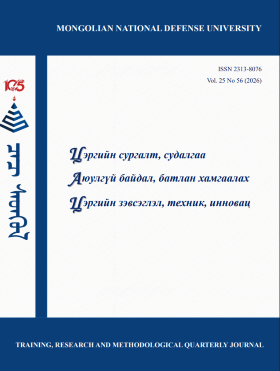
[17] Lkhagvadorj Bayarsaikhan. "Methodology for the evaluation of innovation outputs”. MNDU᠃ TSATS (Training, Research and Methodological Quarterly Journal) Vol. 25 No 55 (2026) https://mndu.gov.mn/2026/. https://doi.org/10.65902/tsats.2026.01.005
Downloads
Published
Issue
Section
License
Copyright (c) 2026 Ideshnorov Demberel, Enkhchimeg Dolgorsuren, Gerelchimeg Kaliinaa, Lkhagvadorj Bayarsaikhan

This work is licensed under a Creative Commons Attribution 4.0 International License.
Copyright on any research article in the Tsats is retained by the author(s).
The authors grant the Tsats a license to publish the article and identify itself as the original publisher.

Articles in the Tsats are Open Access articles published under a Creative Commons Attribution 4.0 International License CC BY.
This license permits use, distribution and reproduction in any medium, provided the original work is properly cited.