Developing Smart Defence in Mongolia: Trends in the Reform of Defence Education
Keywords:
Smart Defence, Military Modernization, Artificial Intelligence, Defence Innovation, Defence EducationAbstract
The rapidly evolving security environment, characterized by geopolitical competition, cyber threats, artificial intelligence (AI), and autonomous systems, requires new approaches to defence modernization. For resource-constrained countries such as Mongolia, Smart Defence provides a practical framework for enhancing military capability through technological innovation, efficient resource utilization, and institutional adaptation. This study examines the theoretical foundations of Smart Defence and assesses its applicability to Mongolia through comparative analysis, case studies, and document analysis of selected international experiences. The findings indicate that Mongolia should prioritize cyber defence, artificial intelligence, unmanned systems, information security, and digital command-and-control capabilities while strengthening defence education as the foundation of military modernization. Accordingly, the study proposes a Smart Defence Education Model tailored to Mongolia’s national conditions by integrating emerging disciplines—including artificial intelligence, cyber security, opensource intelligence, drone operations, and cognitive warfare—into military education. The proposed model provides a practical framework for defence policy development, military education reform, and the long-term modernization of Mongolia’s national defence system
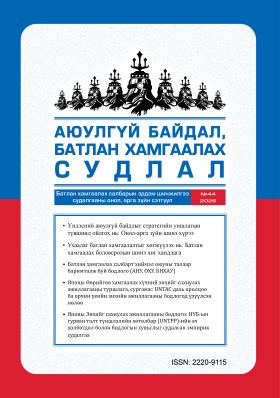
Ухаалаг батлан хамгаалалтыг хөгжүүлэх нь: Батлан хамгаалах боловсролын шинэ чиг хандлага
Геополитикийн өрсөлдөөн, кибер аюул занал, хиймэл оюун, автономит систем зэрэг технологийн хурдацтай хөгжил нь орчин үеийн аюулгүй байдлын орчныг эрс өөрчилж, батлан хамгаалах тогтолцоог шинэчлэх шаардлагыг улам бүр нэмэгдүүлж байна. Нөөц боломж харьцангуй хязгаарлагдмал Монгол Улсын хувьд ухаалаг батлан хамгаалалт нь технологийн инновац, нөөцийн оновчтой ашиглалт, байгууллагын дасан зохицох чадварт тулгуурлан батлан хамгаалах чадавхыг бэхжүүлэх бодитой арга зам юм. Энэхүү судалгаанд ухаалаг батлан хамгаалалтын онолын үндсийг авч үзэж, олон улсын туршлагад харьцуулсан шинжилгээ, кейс судалгаа болон баримт бичгийн шинжилгээний аргыг ашиглан Монгол Улсад хэрэгжүүлэх боломжийг үнэлэв. Судалгааны үр дүнгээс үзэхэд Монгол Улс батлан хамгаалах шинэчлэлийн хүрээнд кибер аюулгүй байдал, хиймэл оюун, нисгэгчгүй систем, мэдээллийн аюулгүй байдал, дижитал команд удирдлагын чадавхыг тэргүүлэх чиглэл болгон хөгжүүлэхийн зэрэгцээ батлан хамгаалах боловсролыг шинэчлэлийн суурь хүчин зүйл болгон хөгжүүлэх шаардлагатай байна. Үүний үндсэн дээр Монгол Улсын нөхцөлд нийцсэн “Ухаалаг батлан хамгаалах боловсролын загвар”-ыг санал болгож, хиймэл оюун, кибер аюулгүй байдал, нээлттэй эх сурвалжийн тагнуул, дроны ажиллагаа, танин мэдэхүйн дайны чиглэлийг цэргийн боловсролд үе шаттайгаар нэвтрүүлэх арга замыг тодорхойлов. Судалгааны үр дүн нь батлан хамгаалах бодлого, цэргийн боловсролын шинэчлэл, Монгол Улсын батлан хамгаалах тогтолцооны урт хугацааны шинэчлэлд практик ач холбогдолтой.
Түлхүүр үг: Ухаалаг батлан хамгаалах загварчлал; Цэргийн шинэчлэл; Хиймэл оюун; Кибер аюулгүй байдал; Батлан хамгаалах инновац; Батлан хамгаалах боловсрол;.
37
References
1. Alvin Toffler, Heidi Toffler. 1994. War and Anti-war: Survival at the Dawn of the 21st Century. Warner Books.
2. Bisogniero, Claudio. 2011. “Speech on NATO’s Smart Defence Initiative.” NATO’s Smart Defence Initiative. Tallinn: NATO. 1.
3. Clausewitz, Carl von. 1984. On War. Princeton University Press .
4. Committee Security. 2023. Security Strategy for Society. Publication of the Finnish Government.
5. Creveld, Martin L. Van. 1991. The Transformation of War. Free Press.
6. Czosseck, Christian. 2011. “Estonia after the 2007 Cyber Attacks: Legal, Strategic and Organisational Changes in Cyber Security.” International Journal of Cyber Warfare and Terrorism.
7. Henry A Kissinger, Eric Schmidt, Daniel Huttenlocher. 2021. The Age of AI: And Our Human Future. Little, Brown and Company.
8. Lindley-French, Julian. 2014. “Connected Forces Through Connected Education.”
9. NATO. Cooperative Cyber Defense Centre of Excellence. 2023. Annual Report, Tallinn.
10. NATO. 2025. “Defence Education Enhancement Programme (DEEP).” Brussels.
11. NATO. 2022. Madrid Summit Declaration. Official Text, Madrid : NATO.
12. R.V. Hasyn, O.Ia. Ivasechko, M.V. Zdoroveha. 2024. “Nato’s Innovative Projects In The Field Of Defense: The Defense Innovation Accelerator For The North Atlantic (Diana) And The Innovation Fund (Nif).” Scientific Journal Regional Studies.
13. RAND Corporation. 2001. Networks and Netwars. Monograph Report , RAND Corporation.
14. Rid, Thomas. 2013. Cyber War Will Not Take Place. Oxford: Oxford University Press.
15. Singer, P. W. 2009. Wired for War. New York: Penguin Press.
16. U.S. Department of Defense. 2022. “National Defense Strategy of the United States of America.” Washington D.C.
Downloads
Published
Issue
Section
License
Copyright (c) 2026 Zagdsuren Boldbaatar, Boldbaatar Amartur

This work is licensed under a Creative Commons Attribution 4.0 International License.
This license enables re-users to distribute, remix, adapt, and build upon the material in any medium or format, so long as attribution is given to the creator. The license allows for commercial use.