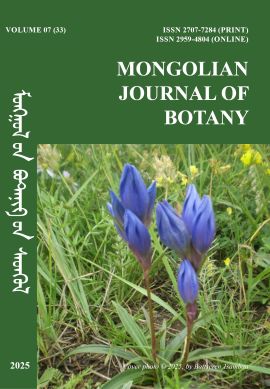
Using maxent to model the distribution of Gentiana decumbens l.f. in Mongolia
Keywords:
Gentiana decumbens, maxent modelling, distributionAbstract
The rapid change in global climate, which is anthropogenic in nature, affects species’ diversity, distribution, and stability. Plants that grow in mountainous regions are increasingly spreading in altitude. The Intergovernmental Panel on Climate Change (IPCC) estimates that air temperatures will increase by 0.2 degrees Celsius per decade in the future. Predicting the distribution of species can be a tool to anticipate future problems in the distribution area of a species, and thus prioritize conservation measures. Therefore, we aimed to map and model the favorable growing environment for the medicinal plant species Gentiana decumbens L.f., which is widely used in traditional medicine throughout Mongolia, and determine future trends. We processed our research materials from 2014 to 2023 and used 249 distribution point data. The distribution was processed using 14 environmental factors. According to the results of the study, when the following 14 environmental factors were considered in the maxent modeling, precipitation in the summer season (June-August) is 32.8%, the average temperature in the spring season (March-May) is 11.1%, the average annual temperature is 10.7%, land elevation is 10.7% and the average temperature in the summer season (June-August) is 9.4%. Other factors accounted for the remaining percentage. The area suitable for the growth of horizontal sedge accounts for 30.11% of the total land area of Mongolia, of which 5.78% is most suitable (in some soums of Uvs, Khuvsgul, Zavkhan, Arkhangai, Orkhon, Bulgan, Selenge, Uvurkhangai, Bayankhongor, Tuv, Khentii, and Dornod province), 5.82% is highly suitable, 6.58% is moderately suitable, and 11.93% is low. However, the remaining 69.89% is unsuitable for growth. When estimating the area of suitable growing areas until 2100, climate change is likely to negatively affect the area of suitable growing areas for the species.
Хэвтээ дэгд (Gentiana decumbens L.F.) ургамлын тархцыг монгол орны хэмжээнд maxent ашиглан загварчлах нь
Хураангуй. Дэлхийн уур амьсгалын хурдацтай өөрчлөлт нь антропоген шинж чанартай болж байгаа нь зүйлийн олон янз байдал, тархалт, тухайн зүйлийн тогтвортой байдалд нөлөөлдөг. Уулархаг бүс нутгаар тархан ургадаг ургамлууд өндөршлийн хувьд дээшилж тархсаар байна. Уур амьсгалын өөрчлөлтийн асуудлаар засгийн газар хоорондын зөвлөл (IPCC) ирээдүйн арван жил тутамд агаарын температур 0.2 хэмээр нэмэгдэнэ гэж тооцоолжээ. Зүйлийн тархалтыг урьдчилан таамагласнаар зүйлийн тархалтын бүсэд ирээдүйн асуудлаас урьтаж судалгааг хэрэгжүүлэх, улмаар хамгаалах арга хэмжээг нэн тэргүүнд тавих арга хэрэгсэл болж чадна. Иймд уламжлалт анагаах ухаанд өргөн хэрэглэгддэг эмийн ашигт зүйл болох Хэвтээ дэгд ургамлыг Монгол орны хэмжээнд тааламжтай ургах орчныг зураглан загварчилж, ирээдүйн чиг хандлагыг тодорхойлох зорилго тавьж ажиллалаа. Бид 2014-2023 он хүртэлх хийгдсэн судалгааны өгөгдлийг боловсруулж 249 тархцын цэгэн мэдээлэл, болон хүрээлэн буй орчны 14 хүчин зүйлсийн үзүүлэлтийн 40 гаруй жилийн өгөгдлийг ашиглан боловсруулалт хийв. Судалгааны үр дүнд maxent загварчлалд дараах 14 орчны хүчин зүйлийг авч үзэхэд зуны улирлын хур тунадас (6-8 сар) 32.8%, хаврын улирлын дундаж температур (3-5 сар) 11.1%, жилийн дундаж температур 10.7%, газрын өндөршил д.т.д) 10.7%, зуны улирлын дундаж температур /6-8 сар/ 9.4%-ийг эзэлж байна. Харин бусад хүчин зүйлүүд үлдсэн хувийг эзэлж байв. Хэвтээ дэгдийн ургахад тохиромжтой талбайн хэмжээ Монгол орны нийт газар нутгийн 30.11% эзэлж байгаагаас 5.78% нь хамгийн тохиромжтой (Увс, Хөвсгөл, Завхан, Архангай, Орхон, Булган, Сэлэнгэ, Өвөрхангай, Баянхонгор, Төв, Хэнтий, Дорнод тус аймгуудын зарим сумд), 5.82% өндөр тохиромжтой, дунд тохиромжтой 6.58%, бага 11.93% тус тус эзэлж байна. Харин үлдсэн 69.89%-д нь ургах орчин таагүй буюу ургах боломжгүй байв. 2100 он хүртэл ургах орчны талбайн хэмжээг тооцоолж үзэхэд уур амьсгалын өөрчлөлт нь Хэвтээ дэгдийн ургах таатай газар нутгийн хэмжээнд сөргөөр нөлөөлөх чиг хандлагатай байна. Түлхүүр үгс: Хэвтээ дэгд, maxent, тархац, орчны хүчин зүйлс, Gentiana decumbens457
Downloads
Published
How to Cite
Issue
Section
License
Copyright (c) 2025 Sukhbat Altangerel, Tuvshintogtokh Indree, Battseren Tsambaa, Lyankhua Bayasgalankhuu, Davaagerel Munkhtur, Nyambayar Nyamjantsan, Batzaya Gachmaa

This work is licensed under a Creative Commons Attribution 4.0 International License.
The authors grant the Mongolian Journal of Botany a license to publish the article and identify itself as the original publisher.

Articles in the Mongolian Journal of Botany are Open Access articles published under a Creative Commons Attribution 4.0 International License CC BY.
This license permits use, distribution and reproduction in any medium, provided the original work is properly cited.