Synthesis of portland cement clinker at low temperature using raw materials from western Mongolia
Keywords:
Portland cement clinker, marlstone, iron ore, gypsum, XRDAbstract
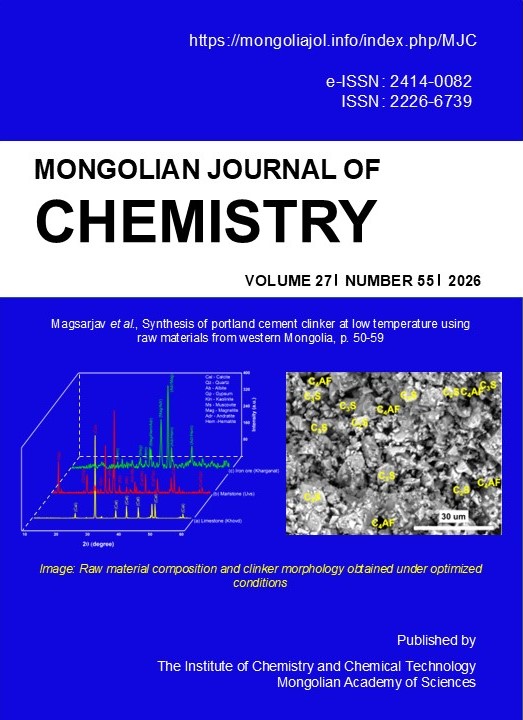
This study evaluates gypsum-assisted low-temperature synthesis of Portland cement clinker using limestone, marlstone, iron ore, and natural gypsum from Western Mongolia. A raw mix designed by Kind’s method (LSF = 0.93; SM = 2.2) was sintered at 1100–1300 °C with 0–2.0 wt.% gypsum addition, and replicated free-lime measurements were used to assess burnability. Increasing temperature markedly reduced residual free CaO, while moderate gypsum addition promoted CaO assimilation. Nonlinear regression identified, within the investigated range, an optimum near 1.39 wt.% gypsum at 1300 °C, corresponding to a predicted free-lime content of approximately 1.25 wt.%. XRD and SEM confirmed the formation of an alite-rich clinker with developed silicate phases. Cement produced from this clinker met the physical and mechanical requirements of MNS 0974:2008 for OPC 42.5 grade, confirming gypsum-assisted clinkerization as an effective route for promoting clinker phase formation at a reduced sintering temperature under the present experimental conditions.
408
References
1. Kamitsou M.D., Kanellopoulou D.G., Christogerou A., et al. (2022) “A Contribution towards a More Sustainable Cement: Synergy of Mill Scales, Greek Wet Fly Ash, Conventional Raw Materials and Clinkering Temperature,” Minerals, vol. 12, no. 324 https://doi.org/10.3390/min12030324
2. Soomro M., Tam V.W.Y., Jorge Evangelista A.C., (2023) “Production of cement and its environmental impact,” Recycled Concrete, p. 11–46. https://doi.org/10.1016/B978-0-323-85210-4.00010-2
3. Zhanikulov N., Sapargaliyeva B., Agabekova A., et al. (2023) “Studies of Utilization of Technogenic Raw Materials in the Synthesis of Cement Clinker from It and Further Production of Portland Cement,” Journal of Composites Science, vol. 7, no. 226. https://doi.org/10.3390/jcs7060226
4. Scrivener K.L., Snellings R., (2022) “The Rise of Portland Cements,” Elements, vol. 18, p. 308–313. https://doi.org/10.2138/gselements.18.5.308
5. Kim T., Kim Y., Kim N., Seo J., Cho J (2024) “Production of High-Strength Cement Clinker Using Slag-Based Industrial By-Products,” Resources Recycling, vol. 33, p. 64–74. https://doi.org/10.7844/kirr.2024.33.6.64
6. Fu J., Guo W., Hu Y., et al. (2024) “Synthesis and properties of belite-ye’elimite-ternesite cement clinker at 1200 °C,” Journal of Sustainable Cement-Based Materials, vol. 13, p. 968–977. https://doi.org/10.1080/21650373.2024.2338539
7.Mrak M., Winnefeld F., Lothenbach B., et al. (2021) “The influence of calcium sulfate content on the hydration of belite-calcium sulfoaluminate cements with different clinker phase compositions,” Materials and Structures, vol. 54, no. 212. https://doi.org/10.1617/s11527-021-01811-w
8. Sun F., Pang X., Wei J., et al. (2023) Synthesis of alite, belite and ferrite in both monophase and polyphase states and their hydration behavior. Journal of Materials Research and Technology, vol. 25, p. 3901–3916. https://doi.org/10.1016/j.jmrt.2023.06.151
9. Boháč M., Krejčí Kotlánová M., Kubátová D., et al. (2024) “Low Energy Alite and Belite-Rich LC3: Early Hydration, Isothermal Calorimetry and Strength Development,” Proceedings of the 7th International Conference on Geotechnics, Civil Engineering and Structures, CIGOS 2024, p. 509–517. https://doi.org/10.1007/978-981-97-1972-3_56
10. Cába V., Sedlačík M., Iliushchenko V., et al. (2022) “Belite-Rich Cement - A more Environmentally Friendly Alternative to Ordinary Portland Cement,” Solid State Phenomena, vol. 337, p. 123–128. https://doi.org/10.4028/p-ap8m7g
11. Khankhaje E., Kim T., Jang H., et al. (2024) “A review of utilization of industrial waste materials as cement replacement in pervious concrete: An alternative approach to sustainable pervious concrete production,” Heliyon, vol. 10, no. e26188. https://doi.org/10.1016/j.heliyon.2024.e26188
12. Rivera Sasso O., Carreño Gallardo C., Soto Castillo D.M., et al. (2024) “Valorization of Biomass and Industrial Wastes as Alternative Fuels for Sustainable Cement Production,” Clean Technologies, vol. 6, p. 814–825. https://doi.org/10.3390/cleantechnol6020042
13. Nandhini K., Karthikeyan J., (2022) “Influence of Industrial and Agricultural By-Products as Cementitious Blends in Self-Compacting Concrete – A Review,” Silicon vol. 14, p. 2431–2452. https://doi.org/10.1007/s12633-021-01043-1
14. Zanoli S.M., Orlietti L., Cocchioni F., et al. (2021) “Optimization of the Clinker Production Phase in a Cement Plant,” Proceeding of CONTROLO, p. 263–273. https://doi.org/10.1007/978-3-030-58653-9_25
15. Albrektienė-Plačakė R., Bazienė K., Gargasas J., (2023) “Investigation on Applying Biodegradable Material for Removal of Various Substances (Fluorides, Nitrates and Lead) from Water,” Materials, vol 16, no. 6519. https://doi.org/10.3390/ma16196519
16. Kognole A.A., Aytenfisu A.H., MacKerell A.D., (2020) “Balanced polarizable Drude force field parameters for molecular anions: phosphates, sulfates, sulfamates, and oxides,” Journal of Molecular Modeling, vol. 26, no. 152.
https://doi.org/10.1007/s00894-020-04399-0
17. Kwon W.T., Kim Y., Lee Y.J., et al. (2009) “Effects of Pair-Mineralizer on Burnability of Clinker and Formation of Mineral,” Materials Science Forum, vol. 620–622, p. 209–212. https://doi.org/10.4028/www.scientific.net/MSF.620-622.209
18. Siddique R., Khan M.I., (2011) “Supplementary Cementing Materials,” Engineering Materials book series, Springer https://doi.org/10.1007/978-3-642-17866-5
19. Juenger M.C.G., Snellings R., Bernal S.A., (2019) “Supplementary cementitious materials: New sources, characterization, and performance insights,” Cement and Concrete Research, vol. 122, p. 257–273. https://doi.org/10.1016/j.cemconres.2019.05.008
20. Olowofoyeku A.M., Ofuyatan O.M., Oluwafemi J., et al. (2019) “Effect of Superplasticizer on Workability and Properties of Self-Compacting Concrete,” Journal of Physics: Conference Series, vol.1378, no. 042088. https://doi.org/10.1088/1742-6596/1378/4/042088
21. Moodi F., Kashi A., Ramezanianpour A.A., et al. (2018) “Investigation on mechanical and durability properties of polymer and latex-modified concretes,” Construction and Building Materials, vol. 191, p.145–154. https://doi.org/10.1016/j.conbuildmat.2018.09.198
22. Wang Z., Xu J., Xia W., et al. (2020) “Research on Interfacial Bonding Properties and Engineering Applications of Polymer Modified Mortar,” E3S Web of Conferences, vol. 198, no. 01045. https://doi.org/10.1051/e3sconf/202019801045
23. Cao Q.Y., Hao T.Y., Sun W., (2013) “Study on Polymer-Modified Concrete for Improving Flexural Toughness,” Applied Mechanics and Materials, vol. 405–408, p. 2815–2819. https://doi.org/10.4028/www.scientific.net/AMM.405-408.2815
24. Yamashita M., Tanaka H., Sakai E., et al. (2019) “Mineralogical study of high SO₃ clinker produced using waste gypsum board in a cement kiln,” Construction and Building Materials, vol. 217, p. 507-517. https://doi.org/10.1016/j.conbuildmat.2019.05.098
25. Bentur A., (1976) “Effect of Gypsum on the Hydration and Strength of C3S Pastes,” Journal of the American Ceramic Society, vol. 59, p. 210–213.
https://doi.org/10.1111/j.1151-2916.1976.tb10935.x
26. Soroka I., Abayneh M., (1986) “Effect of gypsum on properties and internal structure of PC paste,” Cement and Concrete Research, vol. 16, p. 495–504.
https://doi.org/10.1016/0008-8846(86)90087-6
27. Yamaguchi G., Takemoto K., Uchikva H., Takagi S., (1961) “On the influence of gypsum upon the rate of hydration of portland cement,” Journal of the Ceramic Association vol. 69, p. 112–125. https://doi.org/10.2109/jcersj1950.69.112
28. Aksan U., Köseoğlu K., Çelik M.S., (2021) “Enhancing burnability characteristics of low-temperature burnt-cement clinker by recycling phosphogypsum wastes,” Journal of Materials in Civil Engineering, vol. 33(9), no. 04021250. https://doi.org/10.1061/(ASCE)MT.1943-5533.0003786
29. Tserenkhand B., Sanjaasuren R., Solongo P., (2014) “Composition of iron ores from Mongolian western region and its applicability for cement production,” Mongolian Journal of Chemistry, vol. 14, p. 75–79. https://doi.org/10.5564/mjc.v14i0.204
30. Pérez-Bravo R., Álvarez-Pinazo G., Compana J.M., et al. (2014) “Alite sulfoaluminate clinker: Rietveld mineralogical and SEM-EDX analysis,” Advances in Cement Research, vol. 26, p. 10–20. https://doi.org/10.1680/adcr.12.00044
31. Lerch W.M., Bogue R.H., (1926) “Determination of Uncombined Lime in Portland Cement,” Industrial and Engineering Chemistry, vol.18, p. 739–743. https://doi.org/10.1021/ie50199a022
32. Mache E., Rajczakowska M., Cwirzen A., (2025) “Process Residues in Cement Clinker Production: A Review,” Waste Management Bulletin, vol. 3, no. 100205. https://doi.org/10.1016/j.wmb.2025.100205
33. Taylor H.F.W., (1997) “Cement chemistry” (2nd edition). Thomas Telford Publishing, p. 0–470, https://doi.org/10.1680/cc.25929
34. Kacimi L., Simon-Masseron A., Ghomari A., et al. (2006) “Reduction of clinkerization temperature by using phosphogypsum,” Journal of Hazardous Materials, vol. 137, p. 129–137. https://doi.org/10.1016/j.jhazmat.2005.12.053
35. Tobón J.I., Díaz-Burbano M.F., Restrepo-Baena O.J., (2016) “Optimal fluorite/gypsum mineralizer ratio in Portland cement clinkering, ” Materiales de Construcción, vol. 66, p. e086–e086. https://doi.org/10.3989/mc.2016.05515
36. Raina K., Janakiraman L.K., (1998) “Use of mineralizer in black meal process for improved clinkerization and conservation of energy,” Cement and Concrete Research, vol. 28, p. 1093–1099. https://doi.org/10.1016/S0008-8846(98)00082-9
37. Idris M.S., Ismail K.N., Jamaludin S.B., et al. (2007) “Comparative Characterization of Clinker’s Microstructure at Different Temperature Zone during Cement Production, ” American Journal of Applied sciences, vol. 4, p. 543–546. https://doi.org/10.3844/ajassp.2007.543.546
38. Benmohamed M., Alouani R., Jmayai A., et al. (2016) “Morphological Analysis of White Cement Clinker Minerals: Discussion on the Crystallization-Related Defects,” International Journal of Analytical Chemistry, vol. 2016, p. 1259094. https://doi.org/10.1155/2016/1259094
39. Mongolian Agency for Standardization and Metrology (2008) “MNS974: 2008 Portland Cement Technical Requirements” Ulaanbaatar: Agency for Standardization and Metrology.
Downloads
Published
Issue
Section
License
Copyright (c) 2026 Rentsenkhand Magsarjav, Ochirkhuyag Bayanjargal, Khasbaatar Dashkhuu

This work is licensed under a Creative Commons Attribution 4.0 International License.
Copyright on any research article in the Mongolian Journal of Chemistry is retained by the author(s).
The authors grant the Mongolian Journal of Chemistry a license to publish the article and identify itself as the original publisher.

Articles in the Mongolian Journal of Chemistry are Open Access articles published under a Creative Commons Attribution 4.0 International License CC BY.
This license permits use, distribution and reproduction in any medium, provided the original work is properly cited.
How to Cite